How Much Does a QuickBooks Cleanup Cost?
Most QuickBooks cleanups land somewhere between $1,500 and $5,000. Simple files come in under that. Complicated ones go well past it.
But if you’ve been searching this question, you’ve noticed that almost every answer prices cleanup by how many months behind you are. That’s the wrong question.
A business running 60 transactions a month on cash basis can be two years behind and still be a straightforward cleanup. A business running 800 transactions a month on accrual, with accounts receivable, accounts payable, and deferred revenue that all have to be rebuilt, can be four months behind and cost three times as much.
Months behind tells you how much work there is. It doesn’t tell you how hard the work is. Price follows the second one.
What actually determines the price?
Here’s what a good bookkeeper is looking at when they quote you, roughly in order of how much it moves the number.
Cash basis or accrual. This is the biggest one and almost nobody mentions it. On cash basis, a transaction is money in or money out, and cleanup is largely a matter of getting things categorized and reconciled correctly. On accrual, you also have to rebuild accounts receivable and accounts payable, sort out deferred revenue and prepaid expenses, and make sure accruals actually reverse. Same number of months, several times the work.
Transaction volume. Not revenue, transactions. A consulting firm doing $2M on 50 invoices a year is a smaller cleanup than a retail shop doing $600K across 12,000 card swipes. Volume is what you’re actually paying for.
How wrong the books are, not just how behind. Untouched transactions are fast. Transactions that were categorized incorrectly, reconciled against wrong balances, and then partially fixed by two or three different people are slow. Undoing work takes longer than doing it. A file nobody touched is often cheaper to clean than one where someone made a real effort.
How many accounts are in play. Every bank account, credit card, loan, line of credit, and merchant processor is another reconciliation and another place for errors to hide.
Payroll. Payroll brings tax liability accounts, quarterly filings, and the need to tie your books to what was actually reported to the agencies. It reliably adds to a cleanup.
Inventory, job costing, classes, or multiple entities. Any one of these moves you into a different tier. Inventory in particular can be its own project.
So what should you expect to pay?
Forget months behind for a second and find your complexity tier first.
Simple. Cash basis. One or two accounts. Under about 100 transactions a month. No payroll, or payroll run through a full-service provider that handles its own filings. No inventory.
Moderate. Cash basis or light accrual. Three to six accounts including a merchant processor. Roughly 100 to 400 transactions a month. Payroll in the books.
Complex. Accrual basis with real AR and AP. More than about 400 transactions a month. Inventory, job costing, classes, or multiple entities. Several merchant processors or payment platforms feeding in.
Once you know your tier, cleanup tends to price out something like this, per month you’re behind:
| Complexity | Per month behind |
| Simple | $150 to $300 |
| Moderate | $300 to $600 |
| Complex | $600 to $1,200+ |
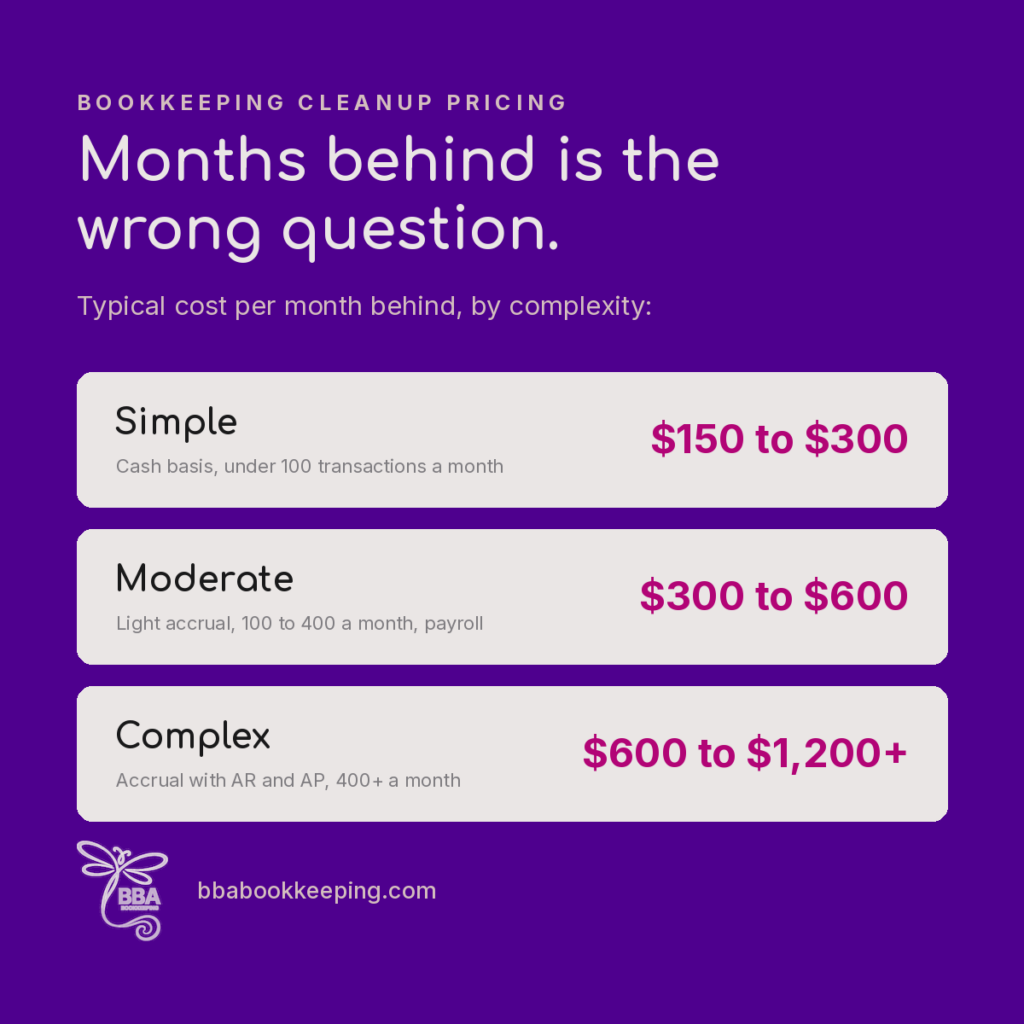
So eight months behind on a simple file can fall between $1,200 to $2,400. Eight months behind on a complex one could be upwards of $4,800 to $9,600. Same eight months.
Use this to sanity check a quote, not to hold anyone to it. If a quote comes in well outside your tier in either direction, ask why. Sometimes there’s a good reason. Sometimes it means they didn’t look closely enough.
Should the cleanup be hourly or a flat fee?
Flat fee, and here’s why that matters to you specifically.
Hourly puts the risk on you. Nobody knows exactly how long a cleanup takes until they’re inside it, so an hourly quote is an estimate that can grow, and you find out what it cost after it’s over.
A flat fee moves that risk to the person doing the work, which is where it belongs. They have to look at your file carefully enough to price it, and once they commit, a surprise on their end is their problem instead of yours.
If a firm will only quote hourly, ask for a not-to-exceed cap in writing.
What should a cleanup actually include?
This is where quotes stop being comparable, so ask specifically. A real cleanup covers:
- Every bank, credit card, and loan account reconciled through the full cleanup period
- Transactions categorized correctly, not just categorized
- A chart of accounts that matches how you actually run your business
- Loan balances tied to real statements
- Payroll tied to what was actually filed
- On accrual, AR and AP rebuilt and agreeing to your own records
- Duplicates and stale uncleared items cleared out
- Opening balances that tie to something real
- A closing balance sheet you can hand to a tax preparer without an apology
If a quote doesn’t say what’s included, it isn’t a quote. It’s a number.
How do you get an accurate price for your books?
Someone has to look inside the file. There’s no way around it, and anyone who quotes you a firm price without doing that is either guessing or planning to revise it later.
That review should be quick, and it should leave you with something useful whether or not you hire the person who did it. A real one tells you what’s wrong, how it got that way, and what fixing it involves. Even if you walk away, you know what you’re dealing with, which is more than you knew before.
Be a little careful with a completely free review. The incentive is to find enough wrong to justify the project. A flat-priced review tends to be more honest, because the person doing it gets paid either way.
What this looks like at BBA
Every new client starts with a Reality Check, a flat-priced deep dive into your current QuickBooks Online file. It takes about a week. You get a written breakdown of what’s actually wrong, how it happened, and what a cleanup would involve, along with a fixed quote for the work.
Most people who come to us already suspect something is off. They just can’t point at it. The Reality Check is how you find out, and the document is yours either way.